
Data centers run on uptime. Any threat to hardware performance, cooling efficiency, or air cleanliness is a threat to operations. Air Purifiers, Inc. designs and installs data center air filtration systems that protect mission-critical equipment, support ISO and ASHRAE compliance, and help facilities maintain the environmental controls on which uptime depends.
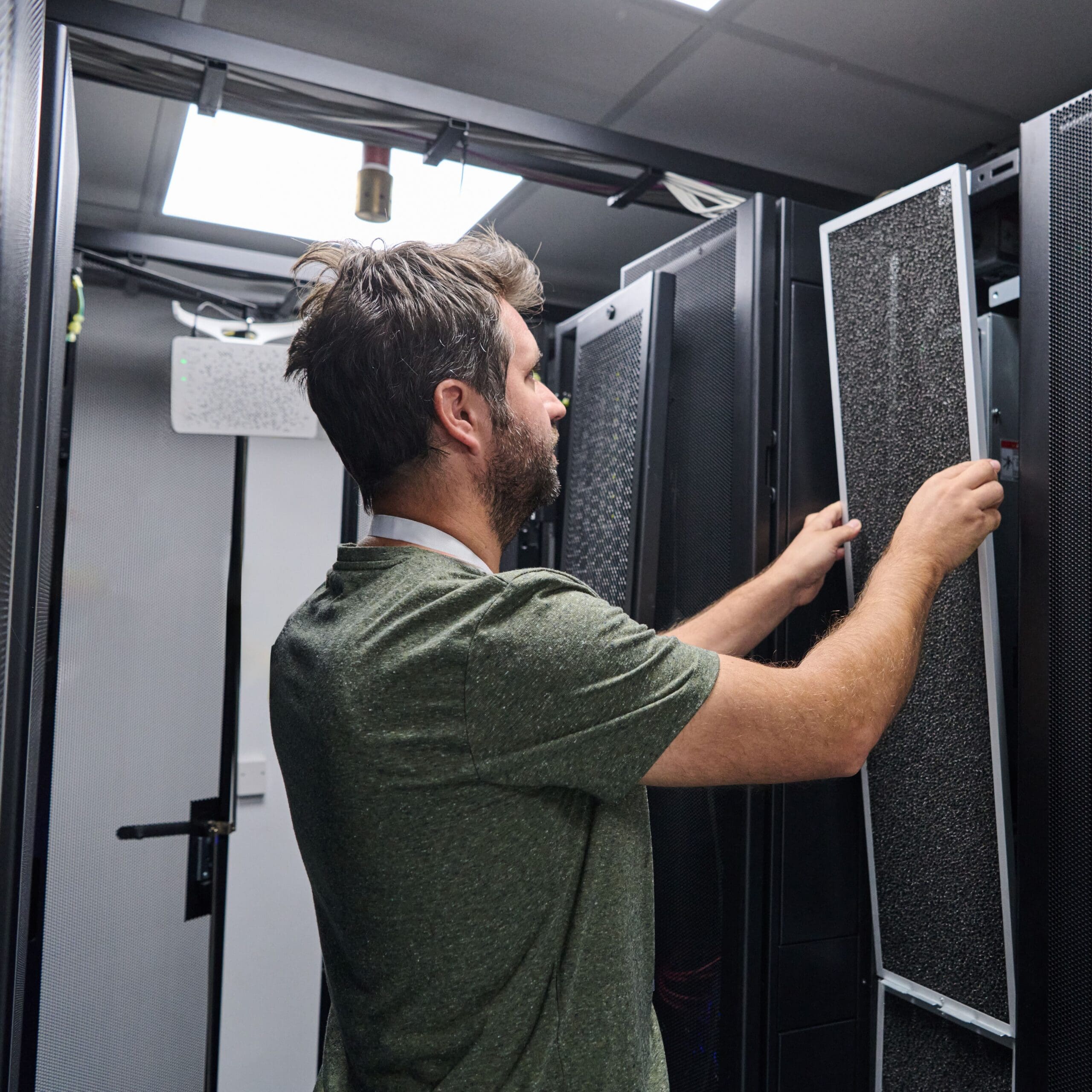
Every data center is an investment in continuous operation. When airborne contaminants enter that environment unchecked, the consequences go well beyond dusty surfaces. Sub-micron particles accelerate hardware failure. Gaseous pollutants corrode copper and silver contacts. Overheating events from clogged airflow paths force unplanned shutdowns.
Data center air filtration is not a one-filter solution. High-performance facilities use a staged approach that addresses particles at multiple size ranges and also controls gaseous contaminants. Here is how a properly engineered system is typically structured.
Pre-filters capture large particles before air reaches downstream filtration stages, protecting higher-efficiency filters from premature loading and reducing replacement frequency and maintenance costs across the system.
MERV 13A through MERV 16 filters rated under the ASHRAE 52.2 Appendix J MERV-A standard capture particles down to 0.3 microns and maintain that efficiency throughout the full operational life of the filter.
HEPA filtration captures 99.97 percent of particles at 0.3 microns while ULPA filtration reaches 99.9995 percent efficiency at 0.12 microns, making both appropriate for white space environments and ISO Class 5 or better applications.
Activated carbon and potassium permanganate media address ISA-71.04 G1 gaseous contamination severity levels, neutralizing corrosive compounds that particulate-only data center air filtration systems cannot capture.
Effective data center air filtration starts with accurate system sizing, and Air Purifiers, Inc. evaluates airflow volumes, contamination sources, and facility layout to specify the right combination of filter stages for each application.
Two standards define the air-quality benchmarks that most data centers are expected to meet. Air Purifiers, Inc. designs data center air filtration systems to help facilities achieve and maintain both.
Compliance is not a one-time achievement. Filtration systems must be properly sized, correctly installed, and consistently monitored to maintain these standards over the life of the facility.
Filter replacement timing depends on your environment, not the calendar. Here is what drives a smarter maintenance approach.
Tying filter replacement to actual operating conditions rather than arbitrary intervals protects hardware, reduces unnecessary spend, and keeps your data center air filtration system performing as designed.
Data center facilities vary widely in scale, structure, and operating environment. There are filtration solutions for a full range of configurations.
Large-scale data centers require airflow management across significant square footage and multiple air-handling paths. Filtration at this scale involves coordinating pre-filter, secondary, and molecular stages across multiple AHUs, maintaining consistent pressure relationships between hot and cold aisles, and planning for filter changeouts that minimize operational disruption. Air Purifiers, Inc. designs systems with the scale and redundancy that hyperscale and colo environments demand.
Edge deployments face a different set of challenges. These facilities are often located in environments with limited climate control, variable outdoor air quality, and reduced maintenance staffing. Compact, high-efficiency filtration that performs reliably and requires fewer service visits is the priority. Air Purifiers, Inc. specifies filtration for edge sites based on local air quality data and facility access constraints.
Containerized deployments add vibration, thermal cycling, and condensation to the list of filtration challenges. Filter media and housing must be rated for the mechanical stresses of mobile and modular operation. Air Purifiers, Inc. selects filtration components appropriate for these conditions so performance holds up regardless of where the unit is deployed.

Data center managers and facility engineers often come to us with the same core questions. Here are straightforward answers to the ones we hear most often.
ASHRAE TC 9.9 recommends a minimum of MERV 11 for data center air filtration, but most professionally managed facilities use MERV 13A or higher. The MERV-A designation under ASHRAE 52.2 Appendix J is the more reliable specification because it reflects real-world filter efficiency under loaded conditions, not just initial performance. For environments with strict ISO cleanliness targets, MERV 16 or HEPA-rated filtration is appropriate.
Clean, properly sized filters maintain lower air resistance through the system. When resistance drops, CRAC and CRAH units operate with less load and draw less power. Over time, a well-maintained filtration system helps lower PUE by reducing the energy burden on the cooling infrastructure. The relationship is direct and measurable.
Particulate filters do not capture gaseous contaminants. Protecting against corrosive gases requires molecular filtration using activated carbon or blended media designed for chemical adsorption. Facilities in areas with elevated industrial air pollution, coastal exposure, or proximity to wastewater treatment should evaluate ISA-71.04 contamination severity levels and specify chemical filtration accordingly.
Filter replacement frequency depends on the local air quality, filtration stage, and facility conditions. Time-based schedules are a starting point, but pressure differential monitoring provides a more accurate indicator of when a filter actually needs replacement. Air Purifiers, Inc. can help establish a maintenance protocol based on your specific environment and system configuration.
HEPA filtration is not required for every data center. Most standard server environments perform well with MERV 13A to MERV 16 filtration. HEPA is appropriate for ultra-clean white space environments, facilities supporting regulated industries, or applications where the cost of any contamination event is extremely high. Air Purifiers, Inc. evaluates facility requirements before recommending a filtration tier.


